Publish before you delete
RepackObjects in go-git could fail, return an error, and leave your repository unable to read its own HEAD. The objects it was supposed to repack were gone, and the pack meant to replace them was never written.
The bug was filed by N0zoM1z0. I reproduced it, fixed it, and the fix merged as #2385. It ships in go-git v6.0.0-beta.1. The fix itself is a few lines. What I want to write down is how an ordinary Go idiom ended up running a delete before the write it depended on.
Loose objects and packs
Git stores every commit, tree and file as an object. A new object is first written as its own small file, a loose object. Over time, repacking gathers those into a single compressed pack, and the loose copies are deleted because the pack now holds them.
That order is what keeps it safe. The loose files can only go once the pack that replaces them is actually on disk.
Where the order flipped
Here is the helper that does the work, trimmed, as it was before the fix:
// createNewObjectPack is a helper for RepackObjects taking care
// of creating a new pack. It is used so the PackfileWriter
// deferred close has the right scope.
func (r *Repository) createNewObjectPack(cfg *RepackConfig) (h plumbing.Hash, err error) {
	// ...walk every ref to find the reachable objects...
	wc, err := r.newPackWriter(ow.promisor)
	if err != nil {
		return h, err
	}
	defer ioutil.CheckClose(wc, &err)

	// ...encode every object into wc...

	// Delete the packed, loose objects.
	if los, ok := r.Storer.(storer.LooseObjectStorer); ok {
		// for each object written to the pack: los.DeleteLooseObject(hash)
	}
	return h, err
}
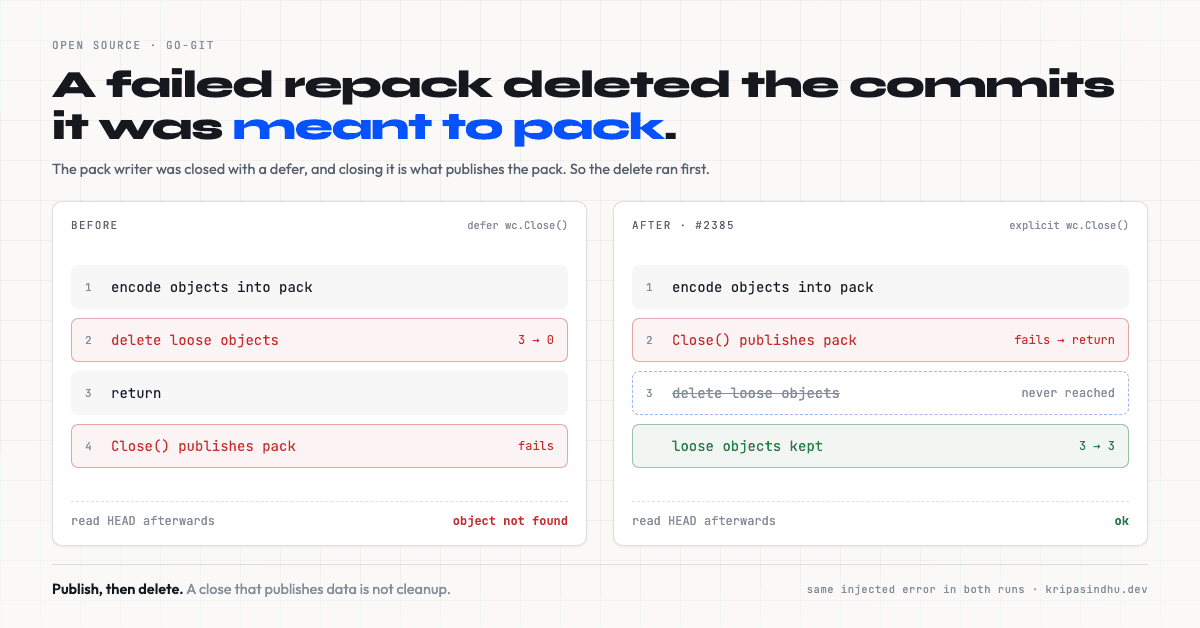
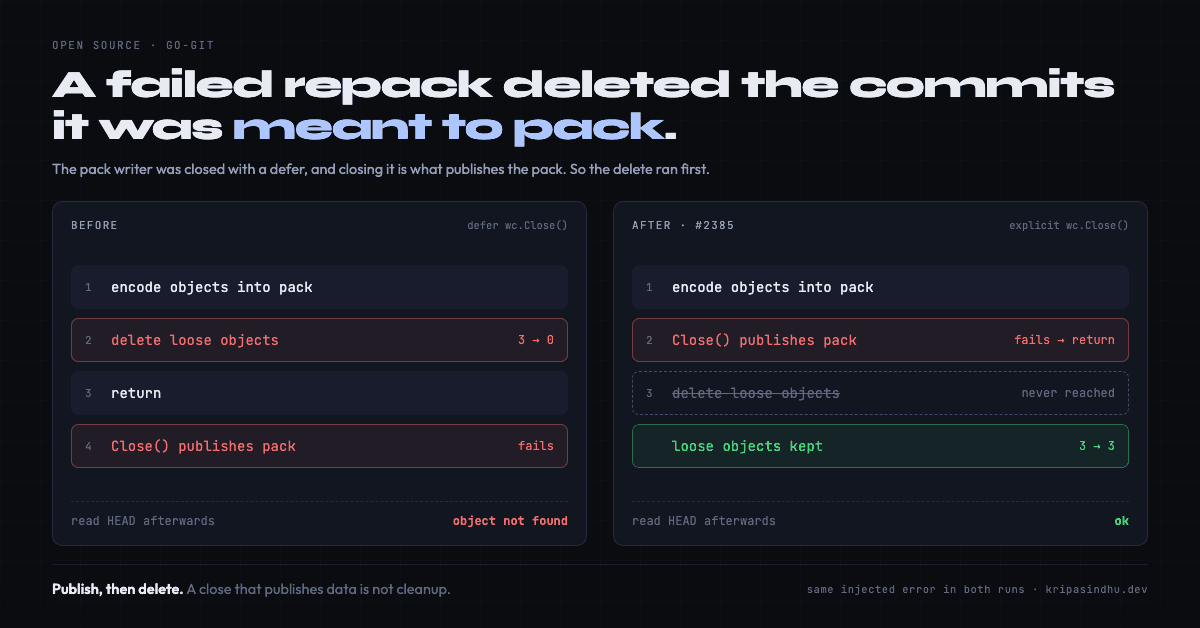
defer runs when the function returns. So the order on the way out is: encode, delete the loose objects, return, and then close the pack writer.
That would be fine if Close only released a file handle. It does not. On disk, PackWriter.Close calls save(), which renames the temporary pack file into objects/pack/. Closing is publishing. Until it runs, the new pack does not exist as far as any reader is concerned.
If that close fails, CheckClose copies the error into err, and the caller gets an error back. By then the loose objects have already been deleted.
The doc comment says the helper exists so the deferred close "has the right scope". The scope was fine. The problem was when the close ran.
Reproducing it
I wanted my own reproduction rather than the reporter's, so I wrapped the filesystem and made only the tmp_pack_ file fail when it is closed. Every byte writes fine; the publish step fails. Same repository, same injected error, run against go-git main just before and just after the merge:
| Before the fix | After the fix | |
|---|---|---|
| Error returned | yes | yes |
| Loose objects | 3 → 0 | 3 → 3 |
| Packs on disk | none | none |
Read HEAD afterwards | object not found | ok |
Both runs return the same error. Only the fixed one still has the commits.
How git does it
go-git expects a behaviour change to match real git, so the next step was reading what git repack does. Three places in git v2.55.0 answer it:
builtin/repack.c:571installs the new packs, and only after that, at:603, does it remove anything redundant and prune loose objects.- Installing a pack is a rename. If it fails, git stops right there, at
repack.c:393:die_errno(_("renaming pack to '%s' failed"), ...). Nothing gets pruned. - Even then, pruning checks each object one more time, at
prune-packed.c:27. It only unlinks a loose object if a pack really contains it:
	if (!has_object_pack(the_repository, oid))
		return 0;
So git publishes first, deletes second, and checks once more before each delete. go-git needed the same order.
The fix, and why the obvious version panics
The fix is to close the writer explicitly, after encoding and before the delete loop, and to return if that fails:
	// Close publishes the pack, so it has to precede the deletion below (#2370).
	closed := false
	defer func() {
		if !closed {
			ioutil.CheckClose(wc, &err)
		}
	}()

	// ...encode every object into wc...

	closed = true
	if err = wc.Close(); err != nil {
		return h, err
	}

	// Delete the packed, loose objects.
The defer stays, but only for the early returns, where it removes the temporary file.
The detail that matters is the line closed = true before the call. My first version set a packPublished flag after a successful close. When the close itself failed, the flag stayed false, the defer closed the writer a second time, and the reproduction panicked:
close of closed channelPackWriter.Close is not safe to call twice. It closes an internal channel unconditionally. So the explicit close and the deferred one have to be mutually exclusive, and the only way to guarantee that is to mark it closed before trying, whether the attempt succeeds or not.
That makes the familiar Go pattern of defer f.Close() plus an explicit f.Close() on the happy path a panic on this type. It is still true after the merge. The reporter and I agreed it belongs in its own issue rather than widening this fix.
The test that passed on broken code
My first regression test passed against the unfixed code.
After the failed repack, it asked the same repository handle whether the commit still existed, and the answer was yes. The reason: when the pack writer finishes parsing a pack, it calls a Notify hook that registers the new pack's index in memory, before save() has written anything to disk. So the handle that ran the repack would happily answer from a pack that never landed. Any other process opening the repository would get object not found.
While developing the fix, I made the test read through a freshly opened storage instead, the same view the next process gets, and it failed on the old code with the real object not found.
The in-memory index turned out to be a bug of its own. Copilot's review pointed at it, and the second commit in the PR makes Notify run only when the close succeeded:
-func (w *PackWriter) Close() error {
+func (w *PackWriter) Close() (err error) {
 	defer func() {
-		if w.Notify != nil && w.writer != nil && w.writer.Finished() {
+		if err == nil && w.Notify != nil && w.writer != nil && w.writer.Finished() {
 			w.Notify(w.checksum, w.writer)
 		}
With that in place, the handle that ran the repack tells the truth too. The merged test injects the failure, checks that the injection actually fired so it cannot pass by accident, then reads the commit and its tree back and asserts that no pack was registered.
Four files, 70 lines added and 3 removed, and most of the additions are the test. The reporter ran the branch themselves before it merged and confirmed the data loss was gone.
What I took away
- If a
Closerenames, flushes or syncs something, it is not cleanup anymore. I would not put it in adeferagain without checking what it actually does. - Do not remove the old copy until the new one is visible to someone other than the code that wrote it.
- A test that reads back through the same handle can be fooled by that handle's cache. Open a fresh one.
- Before designing anything, read how git does it. Here it took three files.
The double close is still open. That is the next thing I would like to see fixed in this corner of go-git.